
Most discussions around Voice AI today revolve around models.
- Lower word error rates.
- More natural sounding voices.
- Larger context windows.
There is an implicit assumption behind all of this: If the AI is good enough, the experience will be good enough.
In practice, this assumption does not hold.
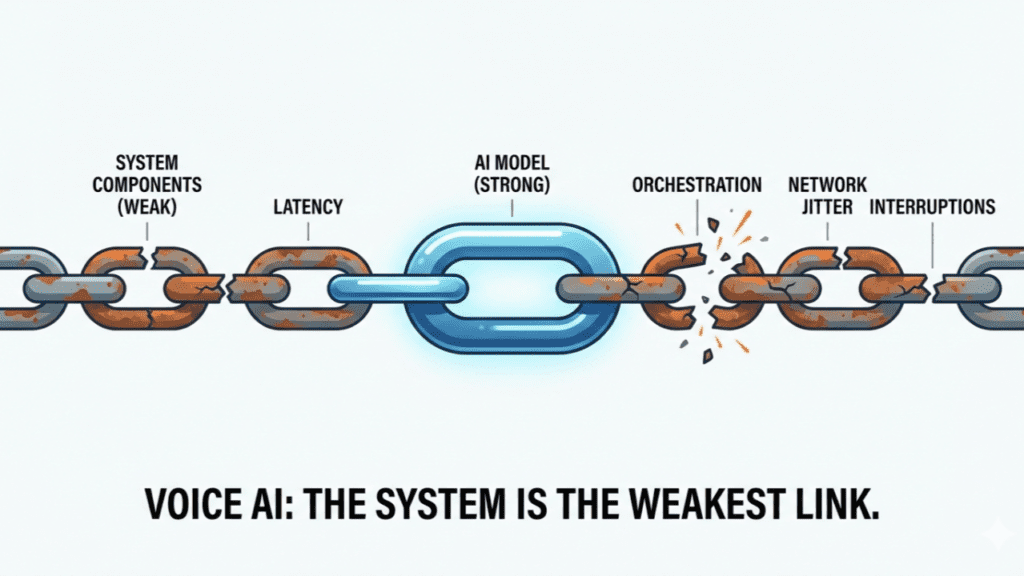
In production systems, Voice AI failures aren’t typically caused by the models being unintelligent. It fails because the system around the models is not designed to operate reliably in real-time.
The Gap Between Demos and Production
Voice AI demos usually work well. They are controlled, low load, and carefully scripted. Production environments are none of those things.
When issues show up, the instinctive reaction is to blame the AI. We assume the STT misunderstood, the LLM replied incorrectly, or the TTS voice felt unnatural. In reality, the models are typically behaving exactly as designed.
What breaks is the coordination between components.
One of the most common failure patterns I have observed in this transition is the Concurrency Trap.
In a demo, making a synchronous (sync) request to an external service is a common shortcut. The system waits, gets the data, and moves on. At low scale, this works fine.
In a high-concurrency production environment, this leads to thread starvation.
You cannot afford “blocked” threads in a real-time system. If a thread waits 500ms for an API, it is effectively dead for that duration. Multiply this by hundreds of concurrent calls, and the entire system grinds to a halt. This is a primary driver of the latency spikes that ruin the user experience.
In production Voice AI, all network I/O must be asynchronous. This ensures the application can context-switch and remain responsive. It is just one example of how a pattern that works in a demo becomes a liability at scale.
What Actually Breaks in Real Voice AI Systems
If you have operated Voice AI systems at any meaningful scale, the problems are predictable.
- Users start speaking while the bot is still talking.
- Streaming STT marks transcripts as final even though the user has not finished speaking.
- TTS continues playing audio even after the user intent has clearly changed.
- Even too many DNS queries will result in DNS servers rate limiting the resolution requests.
A single slow component causes a cascading failure that the user experiences as confusion.
None of these are intelligence problems.
They are systems problems.
Why Voice Is Different From Chat
Voice interaction is fundamentally different from text based interaction.
In chat, delays are tolerated. A response that arrives after a second or two is acceptable. Interruptions are clean and explicit. Silence is neutral.
In voice, timing is everything.
A delay of more than two seconds feels broken. Silence signals uncertainty. Users expect to interrupt and be heard immediately. Conversational rhythm matters more than perfect wording.
A correct answer delivered too late is perceived as worse than an imperfect answer delivered on time.
This is where many Voice AI systems fail. They optimize for accuracy while ignoring interaction quality.
The Voice AI Pipeline Is a Distributed System
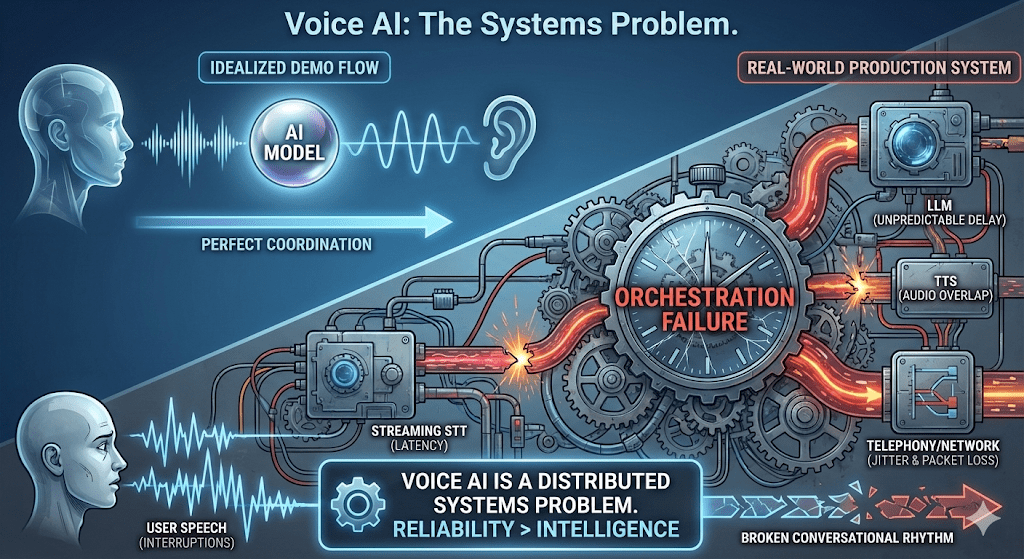
A production Voice AI interaction is not a single model call. It is a real-time pipeline.
- The telephony layer deals with codecs, packet loss, and jitter.
- The orchestration engine might have to resample the audio before sending it to STT.
- Streaming STT produces partial and final transcripts with probabilistic timing.
- LLM responses arrive at unpredictable speeds.
- Streaming TTS must generate audio while remaining cancellable.
- The orchestration engine might have to resample the TTS generated audio before sending it to the telephony layer.
- The output audio must stay aligned with human turn taking.
Each of these components works reasonably well on its own.
The failures happen at the boundaries between them and under time pressure.
Orchestration Is the Hard Part
The hardest problems in Voice AI are not about choosing better models.
They are about making correct decisions under time constraints.
- When is the user actually done speaking?
- When should an LLM request be cancelled?
- When should TTS playback be stopped mid sentence?
- What happens when a dependency partially fails?
- How does the system degrade gracefully instead of failing loudly?
These decisions are timing-related and stateful. They require determinism. They cannot be reliably outsourced to models without losing control.
Most systems try to handle this through best effort logic. That works in demos. It fails under real usage.
What Actually Improves Voice AI Reliability
Teams that succeed with Voice AI focus on engineering fundamentals.
- They use DNS caching and socket reuse to reduce latency.
- They use explicit state machines instead of implicit flows.
- They define clear time budgets for each stage.
- They build first class cancellation paths.
- They apply backpressure in streaming pipelines.
- They measure latency and failure modes, not just accuracy.
In voice systems, reliability matters more than intelligence.
Users prefer predictable behavior over impressive but inconsistent behavior.
The Missing Layer in Most Voice AI Stacks
The ecosystem offers plenty of STT, LLM, and TTS providers.
Very few solutions address coordination, lifecycle management, and real-time decision making.
These concerns are often treated as glue code. Something application teams are expected to figure out themselves.
In production Voice AI, this is a mistake.
Orchestration is not plumbing. It is core product logic.
Rethinking How Voice AI Is Evaluated
If you are evaluating a Voice AI system, the most important questions are rarely about the model.
- How does the system behave under load?
- How quickly does it respond to interruptions?
- How does it fail?
- Can it recover without the user noticing?
- Does it preserve conversational rhythm?
These questions determine real world quality far more than benchmark scores.
Closing
Voice AI will not be won by the smartest models. It will be won by the most reliable systems.
This is the core philosophy I had in mind when I built BotCompose.
We didn’t build another model; we built the “missing layer” of orchestration. By treating Voice AI as a distributed systems problem, we ensure timing and state management are baked into the core, not added as an afterthought.
Teams that succeed will be the ones who stop chasing benchmarks and start building for the real world.
Humans are far less forgiving than benchmarks.