
Sometimes we are asked, why we moved from building and selling end-to-end customer facing products to middleware products. Isn’t what we did was the opposite of vertical integration? Yes, it was, and it was a very conscious decision based on many factors. BTW, this is the 3rd article in the Middleware Musings series, and earlier ones can be found here and here.
Until we started Epicode, the founding team had worked on products that integrated with customer’s multiple third-party enterprise applications, like CRMs, PBXes or their databases. And the approach was end-to-end, taking full responsibility for the implementation and deployment of the solution. If something didn’t work, we got the first call. This is exactly how the majority of small product companies operate.
However, we started noticing many concerns or disadvantages with this approach around 2015 and onwards. I have identified 7 important problems areas, the first 5 being business related and the last two are related to engineering.
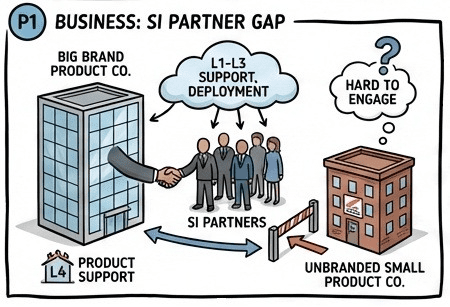
Business: SI Partner Gap
Large product companies outsource their deployment/integration to system integration (SI) partners, so they can focus on the product roadmap, R&D, marketing, etc. Even the product support is restricted to L4, where the SI partner handles L1 to L3. We too wanted these advantages, but it is hard to get SI partners to work with unbranded small product companies.
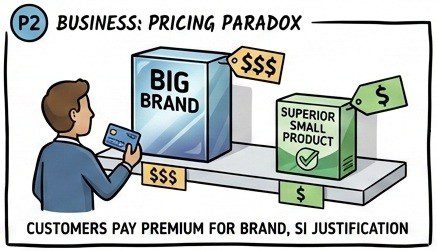
Business: Pricing Paradox
Despite providing superior product experience and service compared to big brand competition, we couldn’t demand a premium price. Meanwhile the customers didn’t have any hesitation paying more to a branded product, which gave good justification for SIs to stick with big brands.
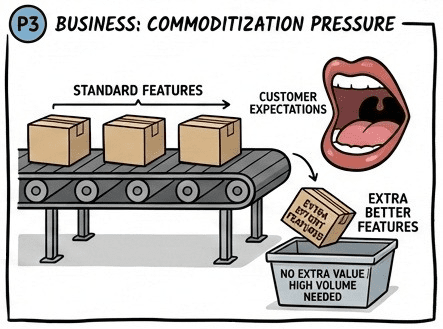
Business: Commoditization Pressure
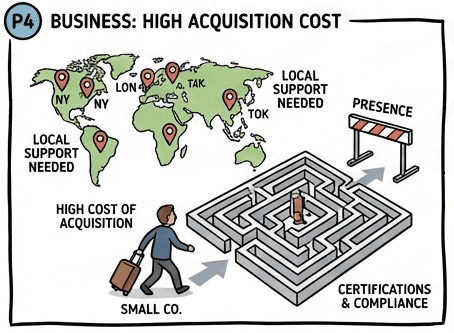
Business: High Acquisition Cost
The cost of customer acquisition is high when trying to win end customers. One needs to have a presence in all the major cities, and customers expect local (same city) support. The end customers usually require various certifications and compliance needs that are hard to be satisfied by product companies directly.
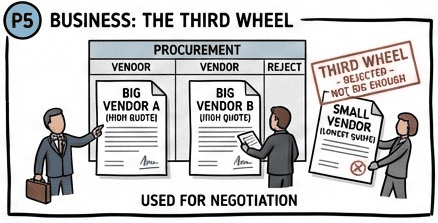
Business: The Third Wheel
Most enterprises are required to assess at least 3 vendors before awarding a contract. A smaller vendor who would have the lowest quote will be used as the third wheel. It satisfies the procurement compliance requirements and the lower quote can be used to negotiate down the quotes from the other vendors. The smaller vendor usually gets rejected for not being big enough.
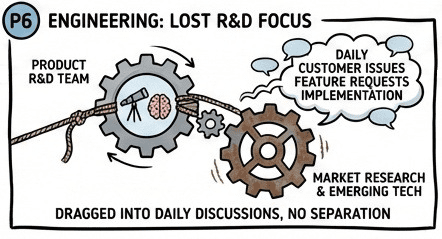
Engineering: Lost R&D Focus
Product development needs a research mindset, the development team shouldn’t be concerned with everyday customer issues or feature requests. They should work based on market research and the emerging technology landscape. However, if the company is also involved in implementing, customizing, and supporting end customers, it becomes very hard to achieve this separation. The product development team will end up getting dragged into daily discussion with the end customers, and will totally lose the required focus.
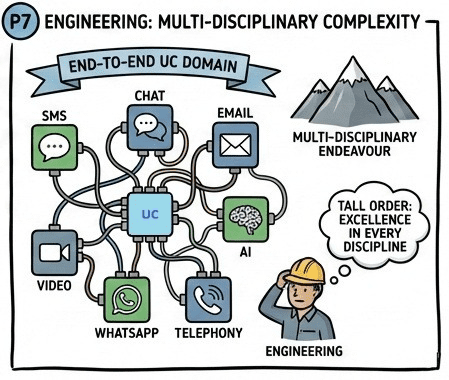
Engineering: Multi-disciplinary Complexity
Finally and most importantly, end-to-end products in the UC domain have become highly multi-disciplinary engineering endeavors. You need expertise in many core areas like SMS, Chat, Email, Video, WhatsApp, AI and Telephony in order to provide end-to-end experience in the UC domain. Reaching excellence in every one of those disciplines is a tall order for any company, let alone a small one. I have previously discussed this problem by calling it the Pentathlon trap.
Well, funding can solve most of these problems by having multiple teams and a big marketing budget. However, P7 is not something that can be solved by throwing money at it, and that was our biggest problem. The proven skills of our founding team was primarily in telephony and highly scalable platforms.
So we stepped back and took a deeper dive into telephony, creating and selling a highly available, highly scalable range of APIs (middleware) that can be used by other telephony application partners and value adding system integrators. We only work with our customers’ development team, and let them deal with end customers. This solved P1, P6 and P7 immediately. That solved the challenges of the engineering team, who could fully focus on product roadmap, research and development.
Meanwhile, interesting things happened on the business side. Let’s start with an analogy. We were making cars, building every part of it, and delivering it to the customers in their cities. The entire marketing, sales, customer service and after sales support around the world was on us. And we could only sell our brand of cars. Then we stepped back and deep dived into just engines, and started selling engines. But we didn’t have to limit ourselves to just car manufacturers. We could sell it to manufacturers of buses, trucks, trains, aircrafts and shipping. Now I am aware that the engine specifications of these different transports are very different and cannot be supplied by one engine vendor. But in telephony, they are the same. Enterprise telephony protocols are the same irrespective of the industry where they are used. Our APIs will work whether you are dealing with mobile phones, landlines, web phones (WebRTC) or WhatsApp.
And the market proved us right. By the second year, our telephony middleware was being used in products running in multiple Fortune 500 companies around the world. The technology partners who use our telephony middleware have the size and brand value to overcome P2, P4 and P5. By the 3rd year we had discovered a new use case, Voice AI. AI service companies know how to solve AI issues, but we know how to solve system engineering problems related to voice communication. By the 5th year, multiple companies with billion dollar annual revenue are using our middleware to build their products. Since we merely focus on one area (voice telephony), we are able to differentiate ourselves from the competition by being a lot more cost effective and providing much higher performance and value to our customers. That took care of P3too.
Now, how did the market benefit from this shift? Let’s go back to the car analogy for a moment. Remember how Fiat used to be a very fringe car seller in India? But they also made engines. In fact, their 1.3L diesel engine was used in 24 different cars from 5 car manufacturers, and therefore called the National Engine. Our strategic shift is making a similar impact in the voice AI industry. While we optimised our business model to reduce our overheads, we also ended up creating a competitive advantage to our partners and end users by providing superior products at competitive pricing. And that’s the story of how we pivoted or strategically shifted our business by stepping back.