
In the current “Voice AI gold rush”, WebRTC is often presented as the default solution for real-time audio. And to be fair, WebRTC is a masterpiece of engineering. It was designed for real-time, peer-to-peer communication over unpredictable public networks, and it solves extremely hard problems like NAT traversal, packet loss, jitter, and adaptive bitrate.
But in enterprise Voice AI architectures, we need to ask a more important question:
Are we solving internet problems, or data center problems?
Because the answer determines whether you should use WebRTC, or whether you’re paying a complexity tax you don’t actually need to pay.
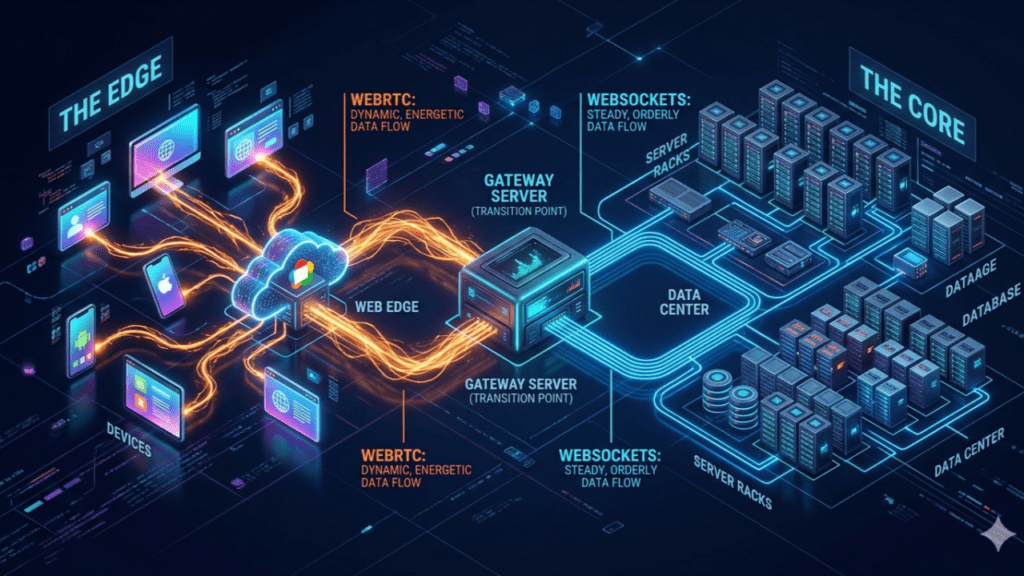
First, Let’s Be Clear: This Is Not Anti-WebRTC
WebRTC is absolutely the right tool in many scenarios. In fact, we at Epicode use WebRTC in production for two critical edge use cases:
1. Customer → Voicebot (Browser Widget)
When partners embed a JavaScript widget on their website and customers click to talk to a voicebot:
- The client is a browser.
- The network is the public internet.
- Users are behind NAT and firewalls.
- Packet loss and jitter are common.
- Low latency matters for human conversation.
This is exactly the environment WebRTC was designed for, and it performs exceptionally well here.
2. Human Agents Using WebRTC Softphones
When a voicebot escalates a call to a human agent through an ACD queue:
- Agents may be working remotely.
- Network quality is unpredictable.
- Latency and audio smoothness matter more than perfect packet delivery.
- Packet loss concealment and jitter buffers are important.
Again, this is a textbook WebRTC use case.
So WebRTC is the right protocol for the edge, where you don’t control the network.
But the story changes completely inside the data center.
The Real Question: What About PBX ↔ AI Orchestrator?
In most enterprise Voice AI systems, the architecture looks roughly like this:
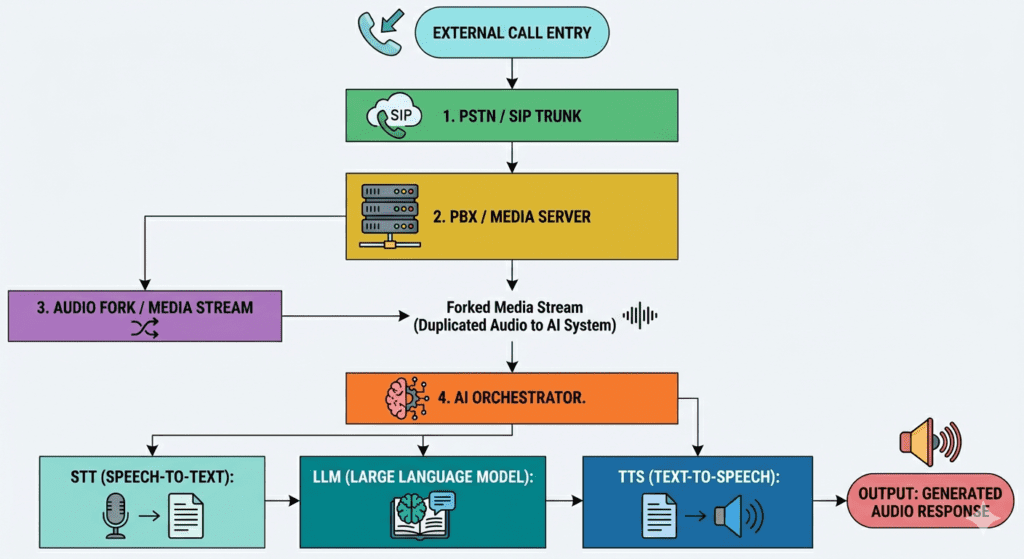
At this point, the media is no longer coming from a browser over 4G or 5G.
It is coming from a PBX or media server inside a LAN or inter-data-center network.
This is a server-to-server, controlled, high-bandwidth, low-packet-loss environment.
And this is where WebSockets often make more sense than WebRTC. Below are five points which elaborate this.
1. Eliminating the "Negotiation Tax"
WebRTC session setup involves:
- ICE (NAT traversal)
- STUN/TURN
- DTLS handshake
- SDP offer/answer negotiation
- Codec negotiation
- SRTP key exchange
This makes sense on the public internet. It makes much less sense when:
- Your PBX already knows the orchestrator IP
- Both systems are in the same LAN or DC
- Codecs are fixed (e.g., Raw PCM at 8kHz or 16kHz, G.711, G.722)
- There is no NAT traversal required
In this environment, a WebSocket connection is just:
- TCP connect
- TLS handshake
- HTTP Upgrade
- Start streaming bytes
Session setup goes from seconds to milliseconds, and the system complexity drops significantly.
2. CPU Efficiency and the Data Plane
This is one of the most important but least discussed points.
WebRTC servers must handle:
- SRTP encryption/decryption per packet
- Jitter buffers
- Packet reordering
- NACKs and retransmissions
- Congestion control
- Adaptive bitrate
- RTP packet processing
But in an enterprise telephony stack, the PBX or media server is already doing most of this.
If your PBX is already handling:
- SIP
- RTP
- Jitter buffer
- Transcoding
- Packet loss handling
Then pushing audio into WebRTC again means duplicating media handling logic and paying the CPU cost twice.
With WebSockets:
- You can stream raw PCM, G.711, or G.722 as binary
- TLS can be terminated at the load balancer
- Internal traffic can be plain TCP
- The AI orchestrator receives a clean byte stream
Also, STT engines prefer continuous byte streams, not RTP packets, which makes WebSockets a very natural fit for AI pipelines.
3. The Multi-Modal Advantage: Audio + Events
Voice AI is not just audio. It includes:
- Audio stream (data plane)
- Voice Activity Detection (VAD) events
- Transcription events
- Speech final / interim markers
- LLM state (thinking / responding)
- Call signals like DTMF
WebSockets support this natively:
- Binary frames → audio (PCM, G.711, G.722)
- Text frames → JSON events and control messages
- Same connection, same session, easy synchronization
You can do this in WebRTC using DataChannels, but that adds another protocol layer and more state management.
Another major advantage: Backpressure.
With WebSockets over TCP:
- If the orchestrator is slow to read when at high load, TCP flow control naturally slows down the sender.
- This prevents buffer explosions and memory issues.
Backpressure in RTP/WebRTC systems is much harder to manage cleanly.
4. TCP vs UDP : The Head-of-Line Blocking Argument
The classic argument against TCP for voice is Head-of-Line (HoL) blocking:
“If one packet is lost, TCP pauses and retransmits, causing a stutter.”
This is true for human listening over the internet.
But for Speech-to-Text, the priorities are different:
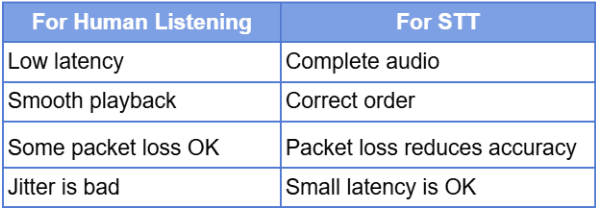
STT cares more about accuracy than perfect real-time playback.
In a LAN or inter-DC environment where packet loss is near zero, TCP’s guaranteed, ordered delivery becomes a feature, not a bug. It ensures the STT engine receives every sample in order without the orchestrator implementing its own reordering logic.
5. The “Dedicated Telco Link” Reality (Especially in India)
In many enterprise telephony deployments, especially in countries like India, SIP trunks from Tier-1 telecom providers are not delivered over the public internet. Instead, the telco brings a dedicated optical fiber link directly into the data center where the telephony stack is hosted, and this link is terminated on a separate network interface on the telephony server.
This is not best-effort internet bandwidth. It is a private circuit with QoS guarantees from the telecom provider. In this setup:
- Bandwidth is guaranteed.
- Latency is predictable.
- Packet loss and jitter are very low.
- The PBX receives a very clean RTP stream.
Once the PBX forwards this audio to the AI orchestrator within the same data center (or over a private inter-DC link), the network is far more reliable than the public internet. In this environment, using TCP (via WebSockets) has a key advantage while giving the received audio to STT:
TCP guarantees that audio is delivered in order and retransmitted if lost. This directly improves Speech-to-Text accuracy.
TCP guarantees that audio is delivered in order and retransmitted if lost. This directly improves Speech-to-Text accuracy.
For human listening, occasional packet loss is acceptable. For Speech-to-Text, lost packets mean lost words.
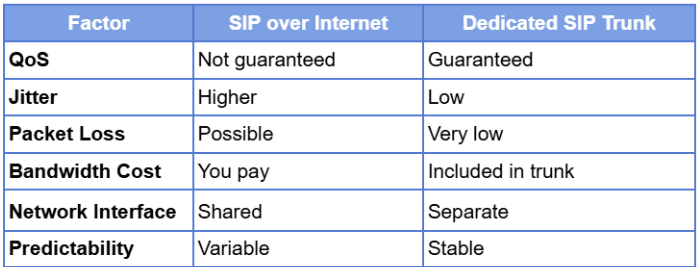
SIP Over Internet (VNO Model)
It’s also worth noting that Virtual Network Operators (VNOs), on the other hand, often deliver SIP over the public internet. In that model:
- QoS is not guaranteed. So jitter and packet loss can increase, especially as call volumes grow.
- Voice traffic shares bandwidth with APIs, dashboards, CRM traffic, backups, and other internet usage.
- If STT/LLM/TTS services are also accessed over the internet, voice and AI traffic compete for the same bandwidth.
- You must provision higher internet bandwidth and redundancy, which increases cost as call volume scales.
- VoIP traffic arrives over the same network interface as regular internet traffic.
With dedicated SIP trunks, VoIP traffic arrives over a separate physical link and separate network interface, so voice traffic does not consume internet bandwidth and call quality remains predictable even at high volumes.
This kind of reliable, QoS-controlled environment makes TCP/WebSocket streaming inside the data center a very practical and robust choice for Voice AI pipelines.
WebRTC vs WebSockets : Where Each Fits
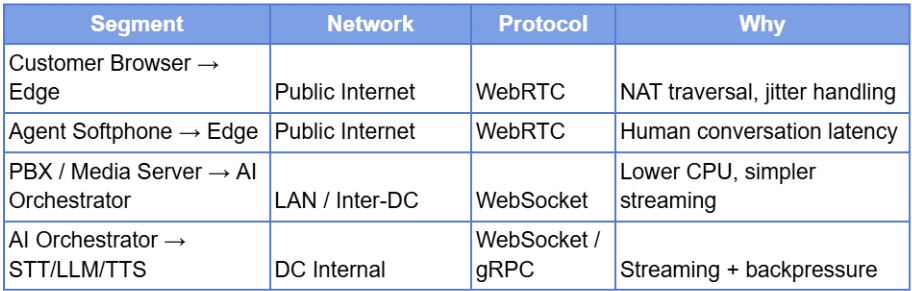
In short:
- WebRTC solves edge network problems
- WebSockets solve data center scaling problems
They are not competitors. They operate in different parts of the architecture.
Industry Reality Check
If you look at most Speech AI providers today:
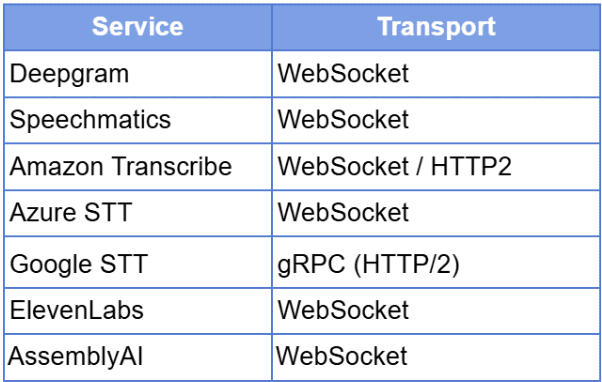
For server-to-server audio streaming, the industry standard is WebSockets or gRPC, not WebRTC.
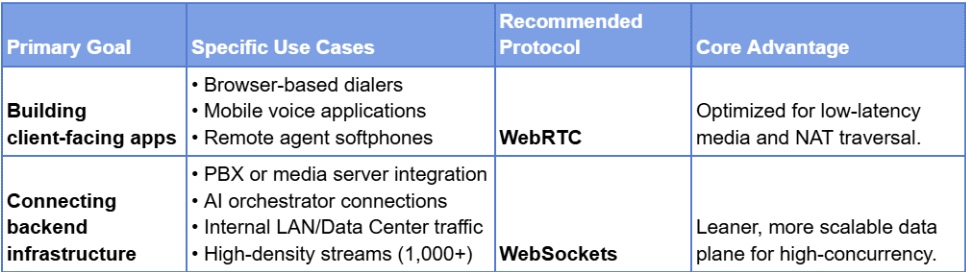
Engineering Verdict
Final Takeaway
The real architectural principle is simple:
- WebRTC is a media protocol for unpredictable networks.
- WebSockets are a data protocol for controlled networks.
- Scalable Voice AI systems need both. Just in different parts of the architecture.
When you place the right protocol in the right part of the system, you reduce complexity, lower CPU usage, and make it much easier to scale to thousands of concurrent calls.
And at scale, architecture decisions matter far more than protocol preferences.